Kirkenes’ Borderland Museum: Read the Town Through Work and Community
The Borderland Museum in Kirkenes offers a way to understand South Varanger beyond its position on a northern map. Varanger Museum describes collections and stories about local communities, industry and wartime history. A focused visit asks how these strands connect, while treating present-day border access as a separate subject.
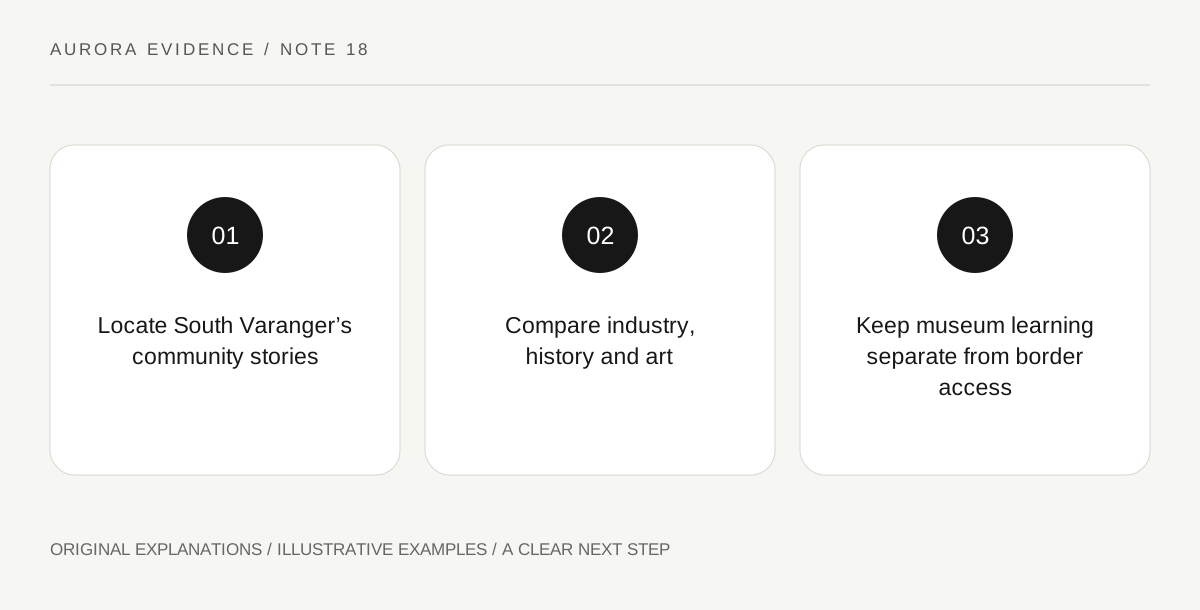
Original explanatory diagram. Read the full method and limitations below.
Begin with the museum’s geographical scope
Varanger Museum identifies the Kirkenes venue with South Varanger and its borderland history. The word borderland describes a place shaped by neighbouring regions and communities; it should not be reduced to a photograph beside a line on a map. Start by locating the communities and landscapes discussed in the exhibitions. Names, languages and historical periods may require careful reading. If a label refers to a particular group or era, preserve that specificity instead of calling every story simply Arctic life. The museum can help visitors understand a local setting that a short evening sky observation would not explain.
Follow the industrial thread
The museum’s account includes the iron-ore company Sydvaranger and the industrial development associated with Kirkenes. Read objects and images as evidence of work, infrastructure and everyday organisation. Ask which people carried out the labour, what the workplace required and how the town changed around it. A mining-related object may tell a different story from a scenic landscape image, even when both concern the same place. Avoid claiming technical production details that the labels do not provide. A useful note links a specific exhibit to a question about how industry shaped settlement and community life.
Give wartime and community accounts room
The venue also addresses wartime history and the region’s varied population. These subjects deserve more than a quick atmospheric description. Read dates and personal testimony carefully, distinguishing a general historical overview from one person’s account. Art associated with Espolin can offer another way of engaging with regional life, but an artwork should not automatically be treated as a literal documentary record. Compare the medium, the caption and the historical context. If a subject is unfamiliar, keep a question for later reading rather than filling the gap with assumptions about the whole region or its present inhabitants.
Plan a museum visit on its own terms
Check the museum’s current opening information, exhibition availability and any language support before choosing the visit. Seasonal operation can affect a northern itinerary, and this article does not freeze a weekly timetable. Give the museum a clear purpose, such as tracing industrial development or comparing community narratives. Its value does not depend on whether aurora appears later. Do not turn the borderland theme into advice about crossing an international border: contemporary entry rules and transport require separate current official checks. Keeping the museum question focused makes the visit useful without extending its evidence into unrelated travel permissions.
Illustrative three-object notebook
A hypothetical visitor selects an industrial object, a wartime account and an artwork with a regional caption. For each, the notebook records the date, the person or community named and one question it raises. The final page asks how the three perspectives describe the same town differently. This is a suggested learning method, not a claim that particular objects or temporary displays will be available on every visit.
Practical checks
Optional checkboxes save only in this browser.
Questions that come up
Is this mainly a place to learn border-crossing rules?
No. The museum addresses regional history and culture. Present-day entry permissions and transport conditions require separate official travel information.
Should the visit depend on an aurora forecast?
Its historical and cultural purpose is independent. Choose it for the subjects you want to understand and check the venue’s own availability.
References and scope
These sources support the factual background. Examples and exercises are original illustrative teaching material. References do not imply endorsement.
- Varanger Museum: Borderland Museum — Kirkenes and South Varanger borderland, industrial and community history; not border-entry advice.