Tromsø’s Planetarium: Use a Film to Build Better Aurora Questions
The Northern Norwegian Science Center’s planetarium offers a structured way to study aurora through a dome presentation. Its programme includes the film Extreme Auroras. Treat the screening as an educational visit with its own language and schedule, then distinguish the projected imagery from any natural display outside.
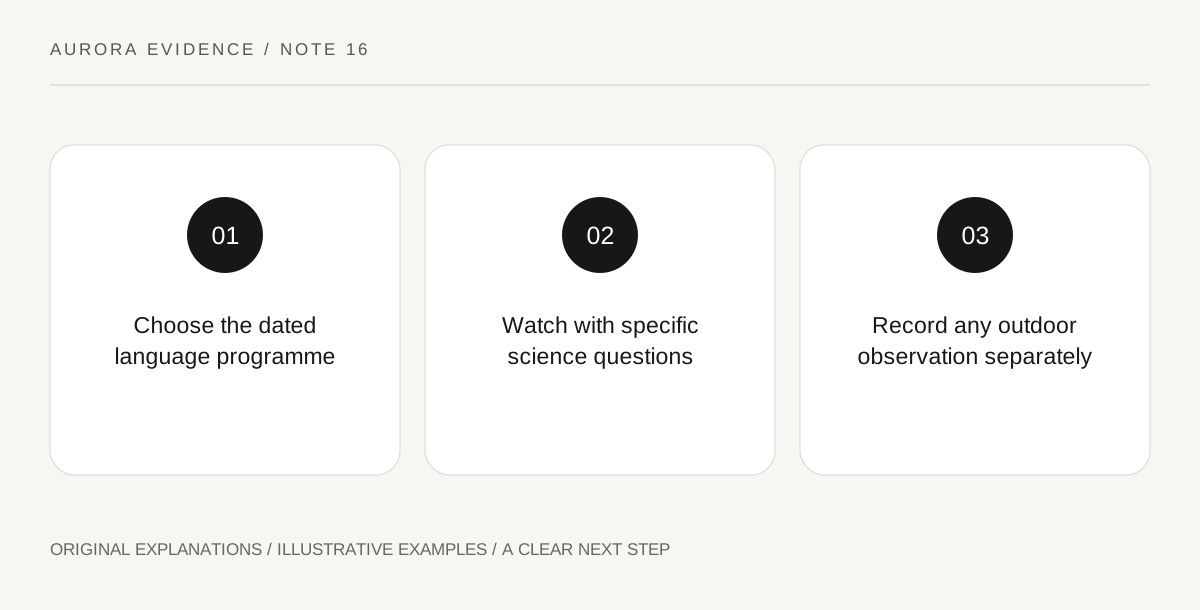
Original explanatory diagram. Read the full method and limitations below.
Identify the actual presentation
The science centre describes Extreme Auroras as a fulldome film featuring aurora imagery by photographer Ole Christian Salomonsen. A dome presentation can show motion and a surrounding visual field in a way that a small phone screen cannot. That format is the attraction being offered. It is not a forecast product and does not mean the sky above Tromsø will reproduce the film that evening. Read the film description before booking so the experience matches your purpose. Someone seeking an explanatory screening has a different expectation from someone seeking a live outdoor observation with an accompanying guide.
Check the dated programme and language
The planetarium publishes a programme with different language versions and dated exceptions. Read the programme for the actual day, including cancellation notices, instead of copying a normal time from an older guide. A show in a language you do not understand can still contain striking images but may not deliver the explanation you wanted. Confirm the film title as well as the start time, because a planetarium can schedule multiple subjects. Allow for the science centre’s own arrival and admission instructions. Prices, opening patterns and special events belong to the current venue information rather than an evergreen article.
Watch with a short question sheet
A useful question sheet focuses attention without turning the film into an examination. Ask which shapes change through a sequence, how the presentation distinguishes scientific explanation from imagery and what information is provided about the places shown. If the narration discusses colour or the Sun-Earth connection, compare the language with an authoritative science source later. Do not assume that every frame is accompanied by a complete technical caption. The film is a curated presentation. Keep any unanswered questions open rather than inventing camera details, exact locations or scientific measurements that the venue has not supplied.
Carry the learning into an honest observation
After the screening, write down two ideas you understand more clearly and one point you want to investigate. If you later look at the real sky, use a fresh observation record with the time, location and conditions. Do not merge the film’s most dramatic imagery into a description of your own evening. A cloudy night does not invalidate the educational visit, and a visible display does not make every film detail locally applicable. The two experiences can complement each other because one offers an organised explanation and the other provides a particular, limited encounter with a changing natural phenomenon.
Illustrative post-screening note
A hypothetical visitor writes “the film helped me recognise a curtain-like form” and “I still need to understand the camera viewpoint.” Later, the visitor records only cloud at a permitted outdoor location. Both notes are valid outcomes. The example does not claim that the visitor saw the film’s display in person, and it leaves the unresolved technical question for a reliable scientific source.
Practical checks
Optional checkboxes save only in this browser.
Questions that come up
Is a planetarium screening a live aurora forecast?
No. It is a scheduled presentation. Read its description for the subject and format, and use current scientific products for an actual forecast.
Can I rely on a normal weekly showtime?
Check the programme for your date. The venue publishes exceptions, and language or film choices can differ between scheduled screenings.
References and scope
These sources support the factual background. Examples and exercises are original illustrative teaching material. References do not imply endorsement.
- Tromsø science centre: planetarium program — Language-specific screenings and dated program exceptions; actual schedule must be checked.
- Tromsø science centre: Extreme Auroras — Fulldome documentary experience distinct from outdoor natural observation.