Egilsstaðir: A Town-Based East Iceland Day Has Its Own Subject
Egilsstaðir can be understood as a service centre for East Iceland rather than merely a name beside an airport. The regional tourism authority links the town with local services and the East Iceland Heritage Museum. Build a town-based learning day around those actual functions instead of assuming a regional driving route is always available.
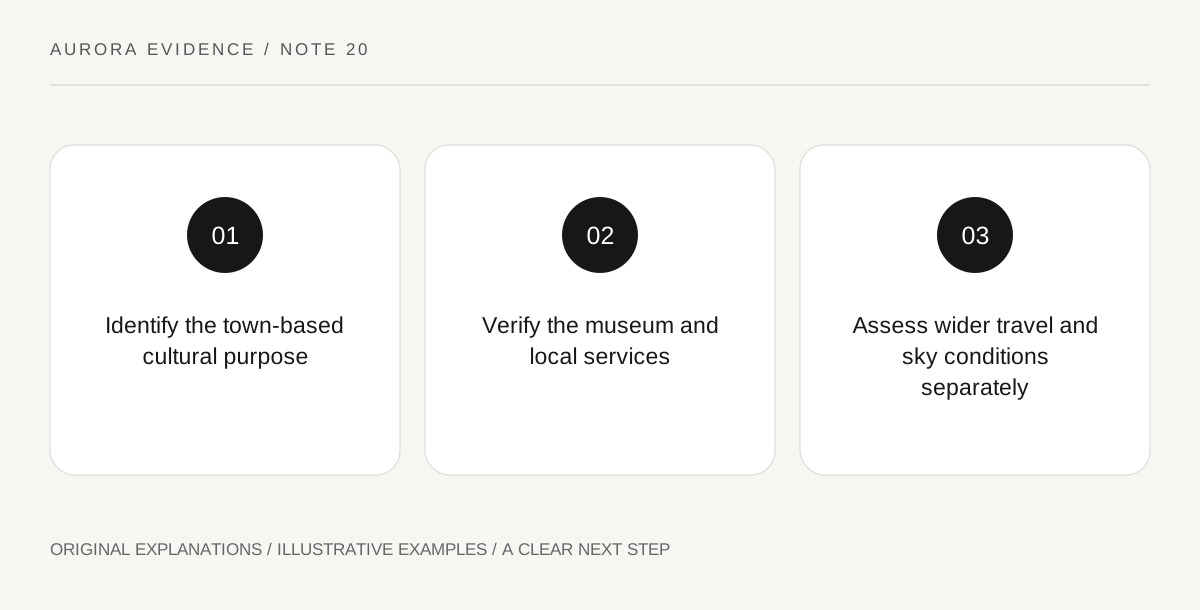
Original explanatory diagram. Read the full method and limitations below.
Separate the town from the wider region
A map of East Iceland contains a large area, while a town visit involves a much smaller set of places. The regional tourism authority describes Egilsstaðir as a hub with services and cultural connections. Identify which activities are actually in town and which require a separate journey. A regional promotional page can place them together thematically without implying that they are all adjacent or walkable. Begin an itinerary with the location of the museum, accommodation and arrival point. Keep distances and transport requirements explicit rather than allowing a broad destination label to hide an additional travel leg.
Use the heritage museum as a research anchor
The East Iceland Heritage Museum gives a town-based visit a specific cultural purpose. Read its own current exhibition and opening information before choosing a topic in detail. A useful question might concern how regional life is represented through objects, stories and landscape. Let the displays supply the actual evidence instead of inventing a list of artefacts from the museum’s name. Record dates, places and communities from the labels when visiting. The method turns a service-town stop into an opportunity to understand the region while keeping claims tied to what the institution actually presents.
Do not inherit a summer route automatically
The regional authority publishes winter-related route information and stresses that services and conditions vary. A named touring circuit is not a promise that every road, attraction or stop is appropriate on every winter date. This article does not reproduce a self-drive circuit or prescribe driving in difficult conditions. If a wider excursion is considered, use current official road and weather information and the relevant operator guidance. A town-based cultural day can be chosen independently of that excursion. Keep it as a complete plan with its own opening checks, rather than an unfinished route awaiting a risky extra journey.
Separate a cultural day from a sky prediction
A day spent learning about East Iceland does not forecast aurora that night. The two subjects require different evidence. Use official current space-weather and local conditions for the sky question, and venue information for the museum question. A regional description of northern-lights opportunities should not be converted into a promise of near-nightly displays. When recording the day, preserve what was learned even if the evening is cloudy. This gives the itinerary a dependable cultural purpose without pretending that indoor access, transport availability or natural phenomena can all be established by one tourism paragraph.
Illustrative hub-day plan
A fictional visitor arrives in Egilsstaðir, confirms the heritage museum’s opening for the next day and chooses one regional-history question to investigate. A proposed out-of-town loop remains a separate, unconfirmed item until current conditions and transport are checked. The evening sky assessment is another row entirely. The plan demonstrates independent decisions; it does not describe a journey undertaken by this author.
Practical checks
Optional checkboxes save only in this browser.
Questions that come up
Does a regional route page prove every winter stop is accessible?
No. A thematic route needs date-specific checks for conditions, services and transport. It should not be treated as a universal winter driving instruction.
Why plan a museum day in an aurora destination?
It gives the visit an independent learning purpose grounded in local culture. Its value can be assessed through the venue’s subject and access rather than an uncertain night-sky outcome.
References and scope
These sources support the factual background. Examples and exercises are original illustrative teaching material. References do not imply endorsement.
- Visit Austurland: winter Riverdale — Egilsstaðir service hub, regional museum and winter service differences; no self-drive route reproduced.
- NOAA: short-term aurora model — OVATION oval, forecast validity, magnetic-pole framing and variable short lead time.