A Sightings Map Also Maps Its Observers
Citizen reports can add valuable local evidence to aurora research. They also reflect where people are present, looking and able to report. Aurorasaurus explains both participation and the geographic biases in its records. A blank area on a report map therefore needs more interpretation than “nothing happened there.”
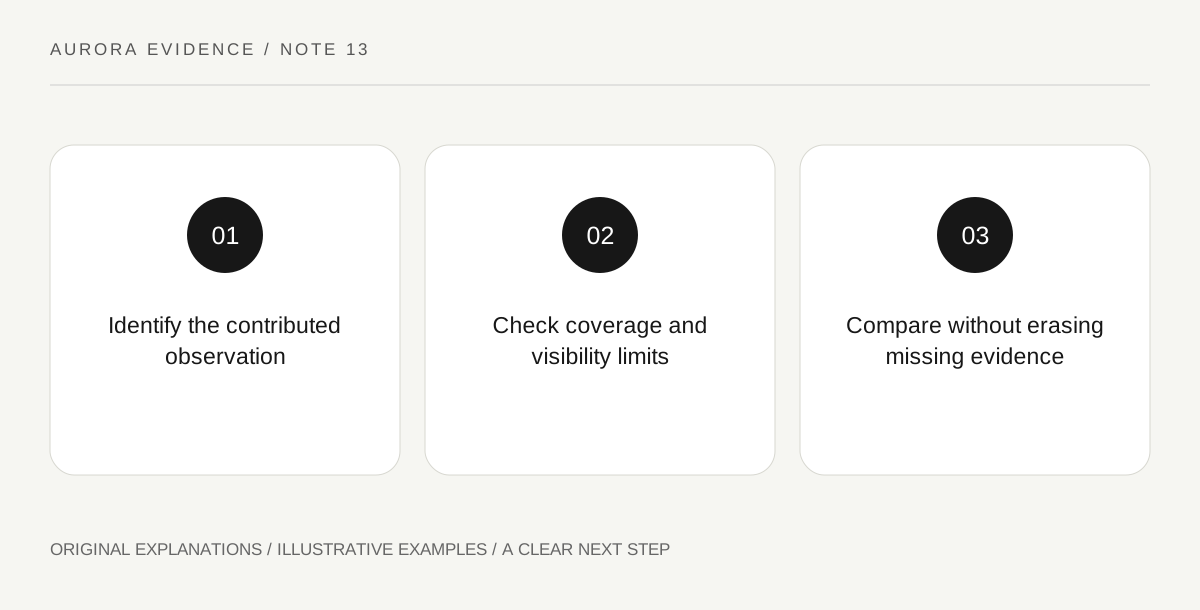
Original explanatory diagram. Read the full method and limitations below.
Separate a report from a continuous survey
A citizen sighting records an observation contributed by a person at a particular place and time. It is not the same as a scientific instrument continuously measuring every location on a map. The observer may have checked once, watched for an interval or reported after returning indoors. Read the report details rather than assuming an entire evening was monitored. A cluster of reports can be meaningful while still leaving gaps between contributors. The map is a collection of evidence, and its coverage depends on the participants as well as on the physical phenomenon being observed.
Recognise the geography of participation
Aurorasaurus has discussed how its records reflect population, observer distribution and reporting behaviour. Places with many interested observers can generate more reports than sparsely populated regions. Connectivity, language and the timing of public attention can also influence participation. Consequently, report density should not be treated as a direct measurement of aurora frequency or intensity without a suitable research method. When describing a map, say that it contains many reports in a region. Do not silently convert that statement into a claim that the aurora itself was stronger there than in every place with fewer contributors.
Keep negative reports and no reports distinct
The project explains that both positive and negative observations can be useful. A person who looked and did not see aurora has supplied information about an observation attempt. An empty map location may simply have no contributor. Those states are different. Even a negative report needs context: time, location and the conditions that affected visibility. If clouds blocked the view, the observation does not establish a clear-sky absence. Keep each qualification attached to the record. When making a teaching example, label its invented reports clearly and never submit synthetic observations to a real scientific service.
Read and contribute responsibly
If you choose to participate, follow the project’s current instructions and account requirements, and report what actually happened. Check the time and location fields, especially for backdated observations. Use the precision requested by the service without publicly adding an unnecessary private address in narrative text. The educational value comes from honest, usable evidence rather than dramatic wording. For readers who only want to interpret the map, no submission is necessary. Compare reports with official instruments and forecasts while preserving their different scopes. Agreement can strengthen a description, but one source should not be rewritten to match another.
Illustrative blank-region comparison
An invented map contains five positive reports near a city, one negative report in a rural village and no entries in a distant valley. The summary preserves all three states. It does not call the valley aurora-free or rank the city as the physically brightest place. A companion note asks how many people were observing and what conditions affected each contributed report.
Practical checks
Optional checkboxes save only in this browser.
Questions that come up
Do more map markers mean stronger aurora?
Not by themselves. More observers or greater reporting activity can produce more markers. Physical comparisons require additional evidence and an appropriate method.
Are negative sightings useful?
Yes, when accurately reported with the relevant observation details. They describe an actual attempt and should remain distinct from areas with no reports.
References and scope
These sources support the factual background. Examples and exercises are original illustrative teaching material. References do not imply endorsement.
- Aurorasaurus: participation — Positive and negative reports, observation time and scientific participation.
- Aurorasaurus: data coverage discussion — Report distribution reflects observers and population, not absolute auroral occurrence.