Read an All-Sky Camera as a View from One Place
An all-sky image can show a broad dome of sky within a single circular frame. The Swedish Institute of Space Physics publishes such observations from Kiruna. To use them well, identify where the camera is, when the image was taken and how the display represents direction.
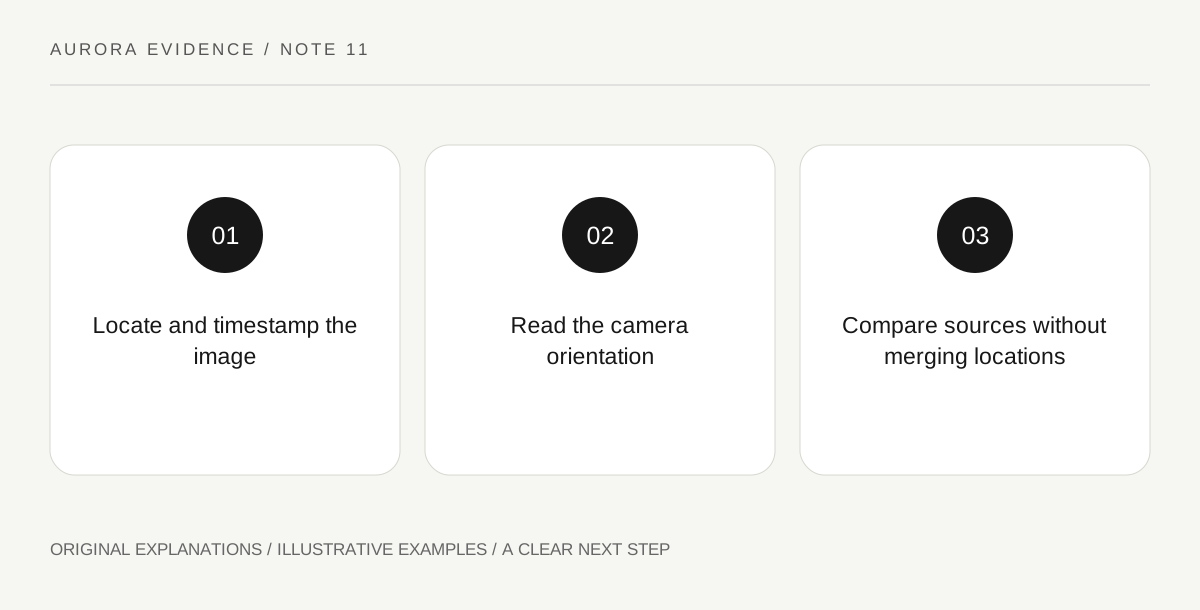
Original explanatory diagram. Read the full method and limitations below.
Locate the observing instrument
The Kiruna camera belongs to a real observing site, so its image answers a location-specific question. It can provide evidence about what was visible to that instrument at the recorded time. It does not show every part of northern Sweden or guarantee the same view from a distant hotel. Begin by recording the station and checking the timestamp. If a page is cached or an image has been forwarded, its delivery time can be later than its exposure time. Keep the image as a dated observation rather than presenting it as a regional live sky window without qualification.
Understand the circular view
An all-sky camera maps a very wide view into an image. The centre generally represents the area overhead and the outer part approaches the horizon, but orientation and projection must be read from the particular instrument’s documentation. Do not translate the right-hand side of a browser window into east by habit. Some camera presentations differ from an ordinary landscape photograph. Use the current labels or a source orientation guide before naming compass directions. Buildings, lens effects and the surroundings can also limit portions of the view, so a circular image does not mean every visible pixel provides equally clear sky evidence.
Distinguish brightness from its cause
A bright area in a night-sky image is an observation to interpret, not an automatic aurora detection. Cloud, moonlight, local illumination, twilight and the camera’s response can affect appearance. Use the sequence and the source explanation to establish context. If the purpose is educational, compare the feature’s changing shape with nearby frames while preserving each time. Avoid declaring that every greenish or pale patch proves a display, especially when the image is small or heavily compressed. When uncertain, describe the visible feature and leave its cause unresolved instead of supplying a confident label.
Compare your view with the camera carefully
A personal observation and a station image can complement one another when their times and locations are explicit. They can also differ for ordinary reasons: cloud distribution, viewing direction, obstructions or the portion of sky being observed. Build a comparison with separate rows for each evidence source. Do not erase a negative personal observation because the distant camera showed aurora, or erase a camera detection because your own horizon was cloudy. A comparison becomes stronger when differences are preserved. It helps explain the limits of regional statements without requiring a traveller to become an instrument specialist.
Illustrative two-location note
Imagine an observer in one town reporting cloud overhead while a timestamped Kiruna camera image shows a structured band. The note keeps both locations and times. It says the camera recorded a feature at its site while the observer’s view was obscured elsewhere. This is a geographical difference in evidence, not proof that either observation is mistaken or that every nearby town shared the camera view.
Practical checks
Optional checkboxes save only in this browser.
Questions that come up
Is the top of an all-sky image always north?
Do not assume that. Check the orientation information supplied for the particular camera and current display before assigning compass directions.
Can I use a camera image from another town as my sighting?
No. It is evidence from that instrument’s location. Keep your own observation separate and describe precisely which source recorded what.
References and scope
These sources support the factual background. Examples and exercises are original illustrative teaching material. References do not imply endorsement.
- IRF: aurora over Kiruna — All-sky camera horizon-to-horizon images and local observation context.
- IRF: all-sky camera and keogram — Central-line slices from minute images form a daily overview; this is a compressed view.