Arcs, Rays and Curtains: Describe an Aurora Before Explaining It
Aurora can appear as bands, curtains, rays or changing patches. Naming a visible form helps an observation become more precise, but a name does not by itself reveal every physical process behind it. A useful field record describes the sequence first and leaves interpretation clearly labelled.
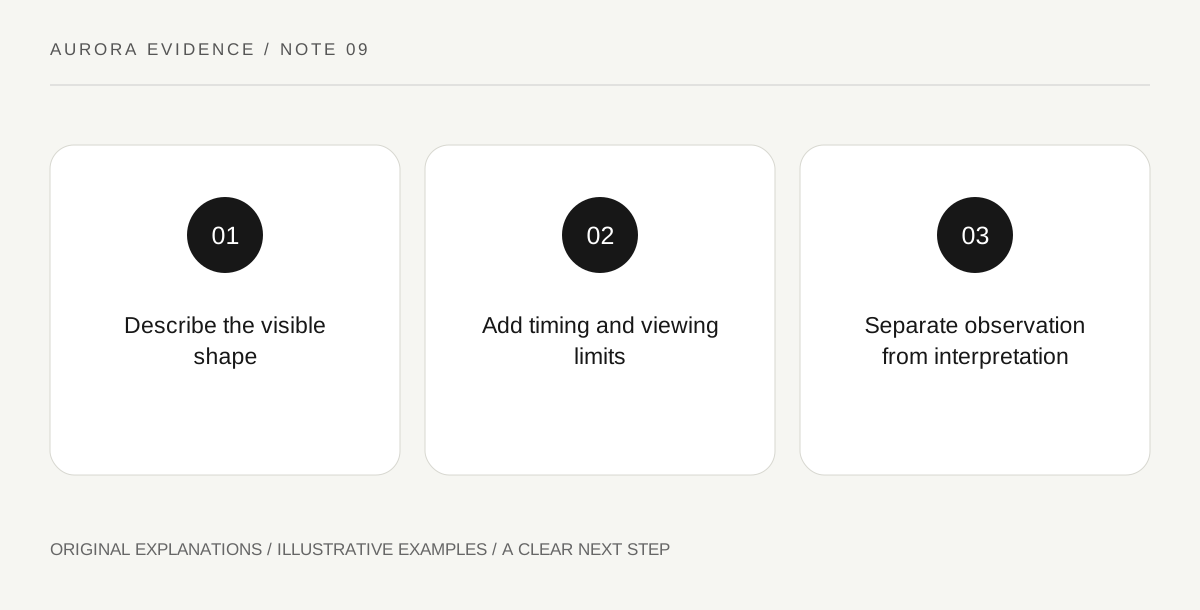
Original explanatory diagram. Read the full method and limitations below.
Use shape words as descriptions
ESA’s aurora material illustrates the changing forms that a display can take. Terms such as arc, curtain and ray give observers a shared vocabulary for apparent structure. Treat them as descriptive tools, not as mutually exclusive boxes that every image must fit. A display can change shape, overlap itself or look different from another angle. If you are uncertain, ordinary language such as “a narrow curved band” can be more accurate than a technical label used confidently. The first task is to preserve what was visible, including the limits of the observer’s view.
Record time as part of the form
A single photograph compresses an event into a frame and may conceal rapid changes or a long period of relative stillness. Describe whether the feature appeared stable, shifted gradually or changed over several observations. Use actual recorded times where available. If you are reconstructing an evening from memory, say so rather than supplying invented minute marks. A sequence of simple sketches with times can be more informative than one elaborate drawing without context. Keep the interval between observations visible so a later reader does not mistake an unobserved gap for continuous monitoring.
Separate apparent movement from an explanation
A curtain can appear to fold or brighten, but the visual impression alone does not measure particle speed or identify a specific magnetospheric mechanism. Perspective also influences apparent form. Record direction and position using an orientation method you understand, and avoid pretending that a hand-drawn horizon is a calibrated instrument. If using a camera view, check its orientation before translating left and right into compass directions. An explanatory article can connect auroral forms with the broader interaction described by ESA while still acknowledging that identifying the detailed cause of a specific feature requires more evidence.
Make a comparison that preserves uncertainty
Compare two observations using the same descriptive fields: time, visible area, shape, apparent colour and change since the previous note. Add viewing limitations such as cloud crossing the field or a building blocking part of the horizon. These are not failures of observation; they explain what the record can support. If a feature disappears behind cloud, write that instead of claiming that the aurora ended. Keep illustrations explicitly illustrative when they do not show a real event. The result is a useful account of evidence rather than a dramatic narrative built from assumptions about unseen parts of the sky.
Illustrative sequence of sketches
A hypothetical observer draws a narrow arc at the first check, several vertical-looking streaks at the next and a partially obscured band later. Each sketch has a time and the same horizon outline. The final caption says that cloud covered the western part of the view. It does not claim the display vanished everywhere or infer a scientific trigger from the sketches alone.
Practical checks
Optional checkboxes save only in this browser.
Questions that come up
Must every display have one official shape name?
No. Overlapping and changing forms can resist a single label. A precise ordinary-language description is useful when a technical classification would overstate certainty.
Can a moving curtain reveal particle speed?
The apparent motion in a casual observation does not directly provide that measurement. Record the visual change without inventing a physical speed or mechanism.
References and scope
These sources support the factual background. Examples and exercises are original illustrative teaching material. References do not imply endorsement.
- ESA: auroral forms — Ribbons, curtains, rays and changing form; image-specific context.