Aurora Colours: What Gas and Altitude Explain, and What a Photograph Cannot
Green, red, pink and blue aurora are clues to light-emitting gases in the upper atmosphere. NASA connects these colours with different gases and heights. The explanation is useful, but a photograph’s colour also depends on how it was captured and displayed, so colour alone is incomplete evidence.
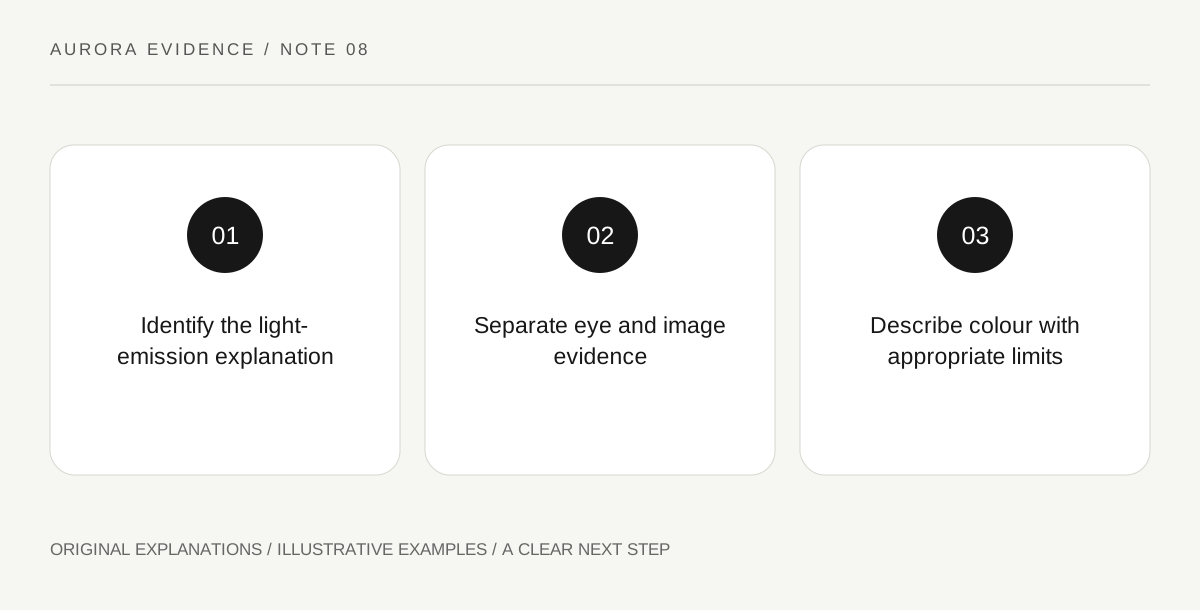
Original explanatory diagram. Read the full method and limitations below.
Begin with emitted light
NASA describes auroral light as a consequence of energetic interactions with gases high in the atmosphere. The gases emit light as part of that process. This differs from a cloud simply reflecting a coloured lamp on the ground. An accessible explanation starts with particles, atmospheric gases and emitted light, while acknowledging that the full physical process is more complex than a three-word diagram. Avoid saying that the atmosphere is burning in the everyday sense. That analogy can suggest combustion and lead readers away from the scientific explanation. The visible display is an atmospheric response within a much larger Sun-Earth interaction.
Connect colour with gas and height
NASA associates oxygen with green and red auroral emissions and nitrogen with blue and pink or purplish contributions. Height matters because atmospheric conditions change with altitude. These associations explain why a single display can contain several colours or vertical differences. They are not a simple ranking in which one colour always means a stronger event than another. A practical learning note links the general colour to the relevant gas explanation, then records uncertainty about any particular image. Do not diagnose an exact emission altitude from an uncalibrated holiday photograph or assign every visible band to a single gas with complete confidence.
Separate the scene from the recorded image
A camera image and a person’s visual impression can differ. Exposure, processing, white balance, screen settings and viewing conditions all influence what a shared image looks like. This article does not prescribe camera settings; its point is evidential. If someone asks why a photograph looks more saturated than their own view, do not treat that difference as proof that either account is dishonest. Preserve the distinction between what the observer saw and what the device recorded. When using an image for teaching, include its provenance and avoid claiming that its displayed colours reproduce the unaided-eye experience for every viewer.
Write a careful colour observation
An observation record can separate shape, apparent colour, timing and the method of recording. A cautious description might say that an observer noticed a pale band while a camera file showed green and a faint reddish upper area. That statement is more informative than converting the image into a numerical intensity rating. Compare the account with the scientific gas explanation, but leave room for uncertainties in the image. For public educational work, use original or properly licensed images and identify whether they are photographs or illustrations. A diagram can explain gas-height relationships without pretending to document a specific night.
Illustrative two-column record
In an invented example, one column reads “faint pale arc seen by eye” and another reads “camera image appears green with a reddish upper edge.” A third column records the device and any known processing. The science note explains oxygen’s relevant emissions. The record deliberately stops short of assigning an exact height or claiming that the observer saw every colour reproduced by the camera.
Practical checks
Optional checkboxes save only in this browser.
Questions that come up
Does red always mean a more powerful display?
No. Colour depends on the emitting gases and atmospheric conditions, including altitude. It is not a universal strength scale for an entire event.
Can a green photograph identify an exact height?
An ordinary photograph alone is insufficient for that precision. Use the general scientific explanation without turning it into an unsupported measurement of a particular scene.
References and scope
These sources support the factual background. Examples and exercises are original illustrative teaching material. References do not imply endorsement.
- NASA: aurora emissions — Oxygen and nitrogen emissions, color and upper-atmosphere relationships.