A Solar Eruption Headline Is Not an Earth-Arrival Forecast
A report of a powerful solar eruption does not automatically describe an incoming event for Earth. Coronal mass ejections involve plasma and magnetic field, and their direction and evolution matter. Read the physical event, the forecast and the possible viewing implications as separate parts of the story.
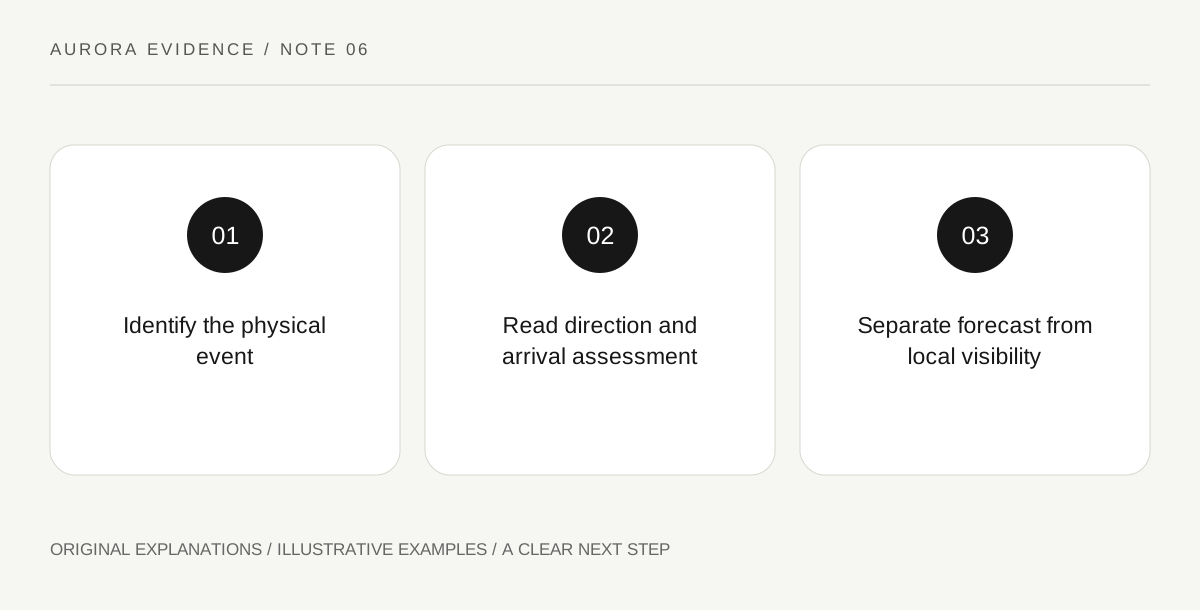
Original explanatory diagram. Read the full method and limitations below.
Separate a CME from a solar flare
NOAA describes coronal mass ejections as expulsions of plasma and magnetic field from the Sun. Solar flares are another kind of solar activity and can occur with an eruption, but the two terms do not describe the same phenomenon. A headline may highlight a flare classification because it is easy to summarise. That classification alone does not establish that a particular mass ejection will reach Earth. Start by finding the official description of what actually happened. Look for an identified CME, its observed direction and whether forecasters consider it relevant to the near-Earth environment.
Direction changes the Earth question
Images of material leaving the Sun can be visually striking without showing a direct Earth encounter. Forecasters analyse observations to estimate an eruption’s characteristics, including speed, size and direction. A projection on an image is not the same as a simple diagram viewed from above. Avoid drawing your own Earth-bound arrow from one frame unless the official analysis supports it. When a notice says the event is being assessed, preserve that uncertainty. A powerful eruption directed elsewhere is a different planning signal from an event officially forecast to affect Earth, even if the pictures look equally dramatic.
Arrival forecasts can be revised
A CME travels through space and interacts with its surrounding environment. Its expected arrival is a forecast, not a booking confirmation. NOAA discusses a range of travel behaviour rather than one fixed journey time for every eruption. Read the latest official assessment and distinguish an arrival window from a precise timestamp. If the forecast changes, compare the issue times before treating two notices as contradictory. The newer notice may incorporate additional observations. Save the source and date when discussing an event so a reader can reconstruct what was known at the time instead of mixing successive predictions.
Translate the notice without promising a display
An expected Earth encounter can inform attention to space-weather products, but it does not guarantee a bright aurora above a particular town. The resulting geomagnetic response and local observing conditions remain separate questions. A useful travel note says what the official notice forecasts, how current it is and what local factors still need checking. It avoids fixed claims such as a universal number of nights after an eruption. For educational use, compare the original notice, later updates and a dated observation record. That sequence teaches forecast development more accurately than a single spectacular image paired with a confident viewing promise.
Illustrative headline check
Suppose a fictional news headline says that a major flare occurred this morning. Your evidence sheet has three separate boxes: flare information, CME analysis and Earth-arrival assessment. The first box can be filled while the other two remain unresolved. Leaving those boxes open is an accurate result. It is better than converting the headline into an invented aurora appointment for tomorrow evening.
Practical checks
Optional checkboxes save only in this browser.
Questions that come up
Do all CMEs reach Earth?
No. Their direction and development matter. Use the official event assessment rather than assuming every visible eruption is on an Earth-intersecting path.
Can a flare rating tell me when to go outside?
It cannot supply a local viewing time by itself. Consult current geomagnetic and aurora products, then consider the actual sky conditions at your location.
References and scope
These sources support the factual background. Examples and exercises are original illustrative teaching material. References do not imply endorsement.
- NOAA: coronal mass ejections — Plasma and magnetic-field ejections, direction, differing travel time and forecast analysis.
- NOAA: short-term aurora model — OVATION oval, forecast validity, magnetic-pole framing and variable short lead time.