Coronal Holes and Recurrence: Useful Context, Not a Repeating Travel Promise
A dark region on an ultraviolet image of the Sun can be associated with a fast solar-wind stream. The name coronal hole can sound like an empty opening, but it describes a particular coronal environment. Its persistence offers scientific context without providing an automatic repeating aurora schedule.
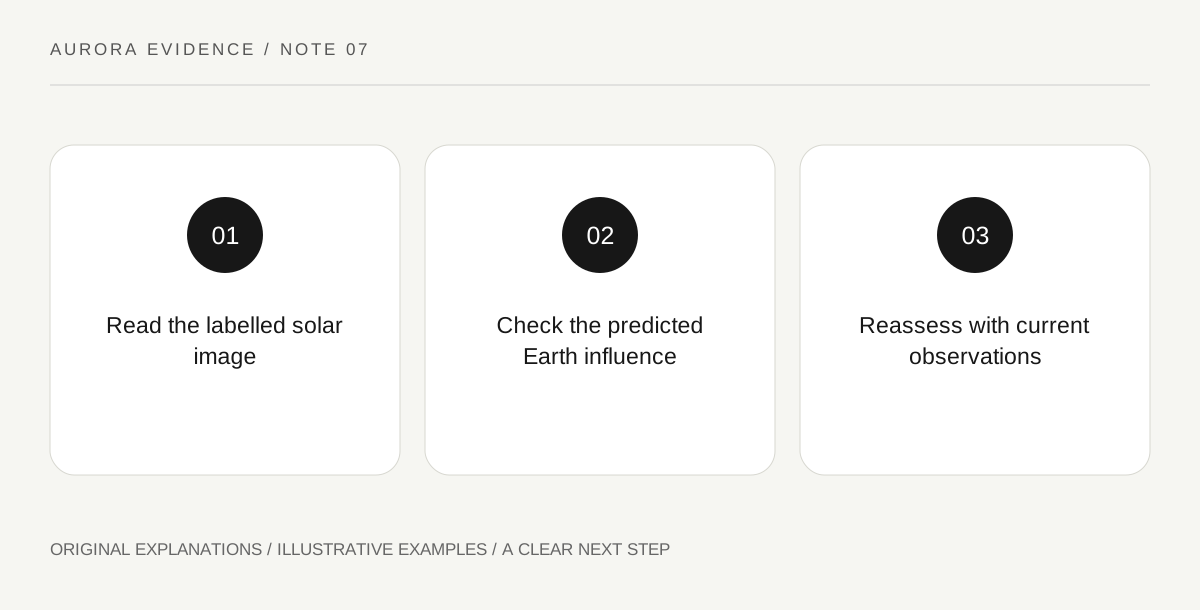
Original explanatory diagram. Read the full method and limitations below.
Understand what looks dark
NOAA explains that coronal holes appear dark in extreme-ultraviolet and some X-ray observations because the material is cooler and less dense than surrounding coronal regions. The darkness belongs to the observing wavelength and the conditions being imaged. It is not an ordinary photograph of a black cavity in the Sun. When reading a shared image, retain the instrument or wavelength label if available. Cropping away those details can invite a false comparison with visible-light photographs. A clear caption describes the observed coronal region and avoids implying that the Sun has lost a solid piece of its surface.
Connect open magnetic structure with solar wind
The official explanation associates coronal holes with open magnetic-field structures that allow solar-wind material to flow outward more readily. These regions can be sources of fast solar-wind streams. Whether a stream affects Earth depends on its location, orientation and the evolving geometry of the Sun-Earth system. Therefore the useful scientific chain has several links: an observed coronal region, an associated outward flow and a possible terrestrial effect. A photograph supports the first link; the current forecast is needed for the later ones. Do not replace that chain with the simpler assertion that every dark region produces a local display.
Use recurrence as a hypothesis
Coronal holes can persist as the Sun rotates, making recurrent influence a meaningful topic for forecasters. Persistence is not permanence, and rotation does not guarantee identical conditions on a later encounter. Regions evolve, their geometry changes and the resulting interaction can differ. A travel calendar that marks a fixed repeating aurora date overstates what this pattern establishes. For a learning exercise, compare dated official images and notices from successive rotations. Record whether the feature was identified again and how the forecast described it. Treat a missing or altered recurrence as evidence to examine, rather than forcing the pattern to fit an expectation.
Keep long-range context separate from tonight
A recurring source may help explain why forecasters are paying attention to a period. It does not replace the short-term solar-wind observations, geomagnetic information or local sky assessment relevant to an actual evening. Keep a notebook column for longer-range context and another for current conditions. This prevents an old prediction from staying mentally active after newer evidence has changed. If you discuss recurrence with another traveller, describe it as a possible influence with a dated source. Do not present it as a reason to buy a particular night’s tour or move accommodation without checking the current situation.
Illustrative recurrence notebook
A fictional notebook contains official image dates from two solar rotations. A dark region appears in a similar part of each labelled image, but the second official notice describes a weaker expected influence. The correct summary preserves both observations. It does not repeat the first notice’s wording simply because the calendar spacing looks regular. The exercise compares evolving evidence rather than predicting a real trip.
Practical checks
Optional checkboxes save only in this browser.
Questions that come up
Does a coronal hole mean the Sun is empty there?
No. The term describes a lower-density, cooler coronal region with a particular magnetic structure. The apparent darkness depends on the observing wavelength.
Can I book around a fixed recurrence interval?
Recurrence can provide context, but it does not guarantee a repeat display. Travel decisions need current forecasts, local conditions and practical flexibility.
References and scope
These sources support the factual background. Examples and exercises are original illustrative teaching material. References do not imply endorsement.
- NOAA: coronal holes — Open-field regions and high-speed streams, possible recurrence and changing impact.
- NOAA: solar-wind data — Upstream L1 measurements, variables, data gaps and selectable primary spacecraft.