Forecast Time Labels: Issued, Valid and Captured Mean Different Things
An aurora screenshot can look precise while leaving its most important detail outside the crop. To interpret a forecast, separate the time it was produced, the interval it describes and the moment somebody saved it. Those three clocks answer different questions about whether the image is useful now.
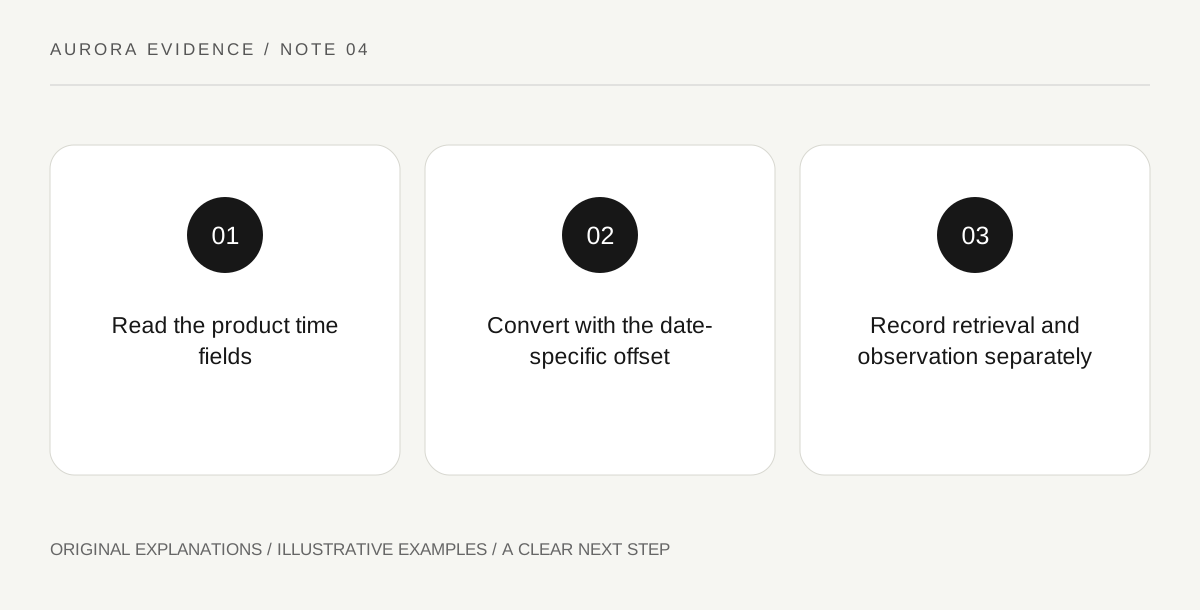
Original explanatory diagram. Read the full method and limitations below.
Start with the forecast product
NOAA describes its aurora short-term forecast as an OVATION model product with a lead time that depends on upstream solar-wind observations. Read the product description before interpreting a timestamp. A label can refer to observation time, forecast time or a displayed interval. Those are related, but they are not interchangeable. A colourful oval saved yesterday remains a historical view even if a social-media account reposts it today. Include the product name and the visible time information when keeping a screenshot. Without that surrounding information, another reader may be unable to distinguish a live forecast from an example used in a lesson.
Convert UTC with an explicit offset
UTC provides a shared time reference for scientific observations. Local civil time requires an offset for the particular place and date, including any applicable seasonal clock change. Do not borrow an offset from a different trip or assume every Nordic destination shares one clock. Write the source time first and the converted local time second. Crossing midnight also changes the calendar date, which can make an evening observation appear to belong to the wrong forecast day. A reliable conversion records the offset used rather than silently changing the number printed on an image.
Preserve the capture time separately
The time a phone downloaded an image tells you when that copy was obtained. It does not establish when the underlying model ran, how recent every input measurement was or whether a newer model frame now exists. A page can refresh while a saved image remains unchanged. Conversely, an old explanatory webpage can contain a current embedded product. Inspect the actual product labels and the source description instead of judging freshness from the surrounding article date alone. Where timing is unclear, describe the image as an undated example and avoid using it to make an immediate viewing decision.
Build a reproducible observation note
A useful notebook separates evidence from interpretation. Record the product, its displayed valid time, its issue or observation time when available, and your own retrieval time. Then write the local conversion and the location to which you intend to apply it. Add a separate sky observation with its own time rather than merging the forecast and the sighting into one statement. This lets you later compare what the model showed with what you actually observed. A mismatch can reflect clouds, daylight, local visibility, timing or the limits of the model; the timestamp alone cannot diagnose which explanation applies.
Illustrative midnight conversion
Suppose an example frame is labelled 23:30 UTC on 10 January and your hypothetical location uses UTC+2 that night. Its local equivalent is 01:30 on 11 January. If you save the frame at 00:15 UTC, that retrieval time is a different field. The arithmetic illustrates a date change; it does not establish the actual clock rules of any destination.
Practical checks
Optional checkboxes save only in this browser.
Questions that come up
Does a fresh screenshot prove the forecast is fresh?
No. It proves when you captured that copy only if your device clock is correct. Inspect the product labels and check the source for newer frames.
Should I replace UTC with local time?
Keep both. UTC supports comparison across sources, while a clearly labelled local conversion helps you relate the information to your evening.
References and scope
These sources support the factual background. Examples and exercises are original illustrative teaching material. References do not imply endorsement.
- NOAA: short-term aurora model — OVATION oval, forecast validity, magnetic-pole framing and variable short lead time.
- IRF: camera data handbook — UTC filenames and keogram axes; historical technical description, not a guarantee of current interface.