Kp Is a Three-Hour Planetary Index, Not a Local Sightings Score
A single Kp number can look wonderfully simple beside a complicated night sky. Its simplicity is also its limit: Kp summarizes geomagnetic disturbance over a defined interval and across a measurement network. Read what the index measures before turning it into a personal probability or a minute-by-minute promise.
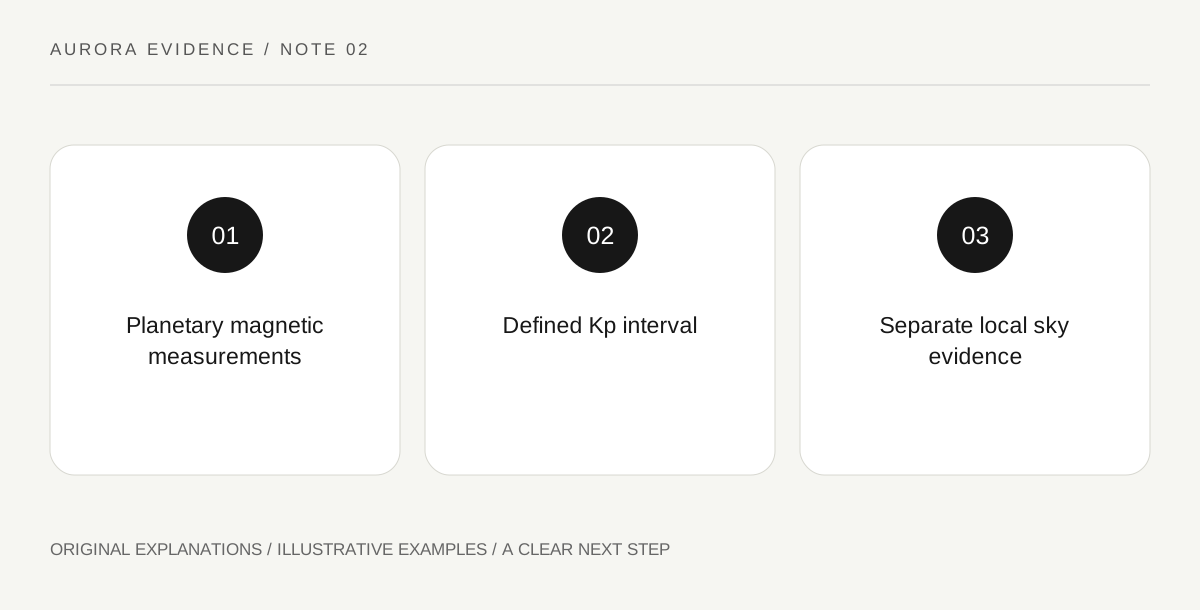
Original explanatory diagram. Read the full method and limitations below.
Begin with the physical quantity and scale
GFZ describes Kp as a planetary three-hour index derived from standardized measurements at a network of magnetic observatories. That makes it different from a camera detecting light over one Nordic town. Keep measurement type, spatial scope and time interval in three separate fields. A planet-scale magnetic summary can be relevant to aurora context without being a direct report of the view outside your accommodation. Do not add a percent sign to the number or treat a one-unit difference as a fixed increase in your personal chance. The index is not defined as a visitor satisfaction or visibility scale.
Separate a recent estimate from a forecast
NOAA’s Kp product includes an estimated three-hour index, while other products can show predicted values. Read the actual label instead of assuming every chart displays future activity. An updated chart can refresh frequently while still describing an interval rather than a single instant. Write whether the value is estimated, observed or forecast according to the provider’s terminology. If two apps show different numbers, first compare those labels and their time windows. A disagreement may reflect different products or periods, so it should not immediately be interpreted as one service making a numerical error.
Use local evidence for the local viewing question
A Kp value does not say whether your part of the sky is cloud-covered, whether nearby lights obstruct the view or whether an auroral form is visible from the exact location. Use appropriate local weather and permitted observations for those questions. This does not make Kp useless; it keeps its role accurate. A visitor in an auroral region should not infer that a modest planetary number means there is no reason to look, nor that a large value removes the need for darkness and a clear view. Read the provider’s regional context rather than applying one universal cutoff copied from a distant location.
Build a note that keeps the index in its lane
Record the product, interval, index type and value, then place your own sky observation in a separate line. If nothing is visible, note whether you had a usable view rather than declaring the index disproved. If aurora appears, do not rewrite the index as though it predicted the exact minute. An illustrative table can show one three-hour interval beside several brief observation windows, making their different temporal resolution obvious. This is a literacy exercise, not a statistical study or a method for calculating a personal sighting probability from a handful of holiday notes.
Illustrative interval comparison
A fictional three-hour Kp interval sits above four short observation notes from one permitted viewing location. Two notes record cloud, one an uncertain glow and one no visible aurora. The learner keeps those local observations separate from the planetary index. No probability, causal conclusion or claim that the invented value was an actual forecast is made.
Practical checks
Optional checkboxes save only in this browser.
Questions that come up
Does a frequently refreshed chart make Kp a minute-by-minute local reading?
No. Refresh rate and the interval represented are different. Read the provider’s definition and product label for the value being shown.
Can a Kp value alone tell me whether I will see aurora?
No. It describes geomagnetic disturbance, while local darkness, visibility and the actual optical display remain separate parts of the question.
References and scope
These sources support the factual background. Examples and exercises are original illustrative teaching material. References do not imply endorsement.
- NOAA: estimated planetary K-index — Estimated three-hour geomagnetic index and distinction from local optical visibility.
- GFZ: geomagnetic Kp service — Planetary three-hour index derived from a magnetometer network.