Direct Glare and Skyglow: Two Different Lighting Problems
A nearby bright lamp can spoil a view even when the wider sky is relatively dark. Broad sky brightness can remain after that lamp leaves your line of sight. DarkSky’s responsible-lighting principles help explain the difference and support practical changes within lighting that you own or are authorised to control.
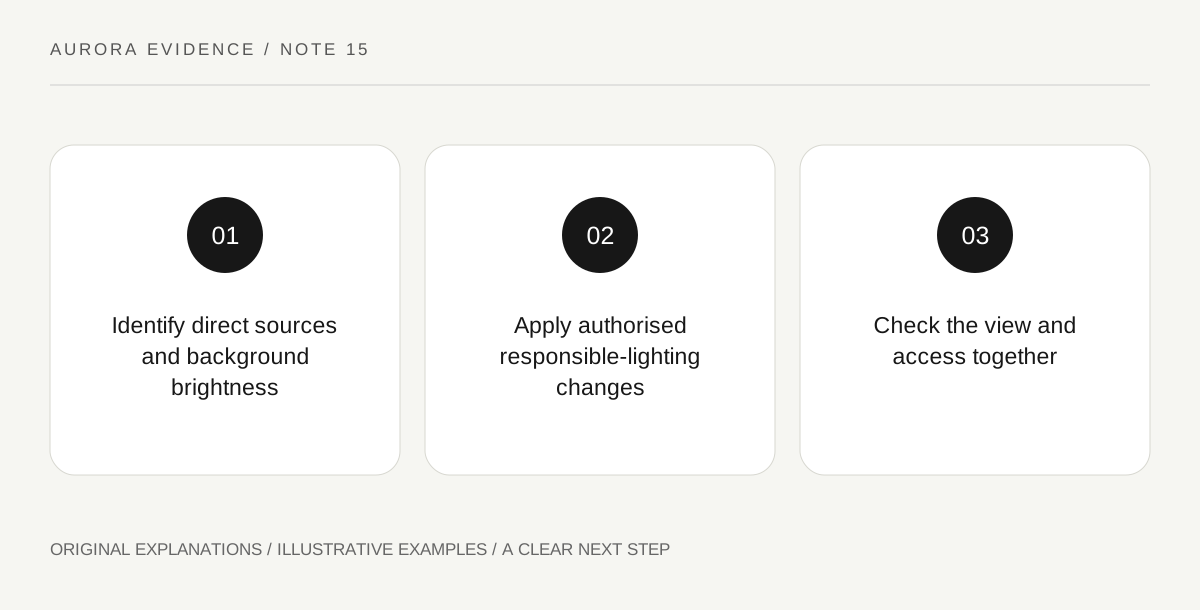
Original explanatory diagram. Read the full method and limitations below.
Identify the source in the field of view
Direct glare concerns bright light reaching the observer’s eyes from a source or a strongly illuminated surface. A lamp beside a doorway may dominate a view even though it lights only a small physical area. First describe where the source is and whether it lies directly in the intended viewing direction. This is a different question from the brightness of the whole sky. A building edge can sometimes screen a source within an already permitted observation area, but the solution should not require entering private land, leaving an authorised path or removing lighting used for safe access.
Recognise wider sky brightness
Light scattered in the atmosphere can contribute to skyglow over a larger area. Hiding one lamp from view does not necessarily remove that background. Conversely, a region with limited overall skyglow can still contain a poorly shielded local light. These distinctions explain why a single label such as “dark location” cannot describe every part of the experience. Record the immediate sources, the horizon and the general sky appearance separately. Do not diagnose all brightness as artificial light; twilight, moonlight, clouds and natural atmospheric effects can also influence what the scene looks like.
Apply the five principles where authorised
DarkSky and the Illuminating Engineering Society set out principles for useful, targeted, low-level, controlled and warm-coloured lighting. The practical emphasis is to provide the light needed for a purpose while limiting unnecessary spill and duration. For lighting you own, that can mean checking direction, shielding, timing and an appropriate output. Warm appearance alone does not excuse excessive brightness or poor aiming. If you are a guest, discuss a specific lamp with the owner rather than operating equipment without permission. Public paths, work areas and emergency access have lighting purposes that an observer should respect.
Document a useful improvement
A simple lighting review can describe the original problem, the authorised adjustment and the resulting view. Keep the camera position and observation method consistent if comparing photographs, and avoid claiming a measured change in sky quality without a proper measurement. A successful adjustment might remove a distracting source while retaining enough light for the entrance. That is a concrete outcome even if distant skyglow remains. For an accommodation discussion, ask about an established observation area and the purpose of its lights. The answer can reveal how the place manages competing needs without requiring a promise of complete darkness.
Illustrative doorway adjustment
A fictional property owner notices that a porch lamp shines horizontally into a permitted courtyard viewing area. After checking access needs, the owner chooses an appropriate shield and timer. The example record says the lamp is less visible from the courtyard while the doorway remains lit when needed. It does not claim that the entire region’s skyglow has disappeared or that aurora visibility is guaranteed.
Practical checks
Optional checkboxes save only in this browser.
Questions that come up
Does warmer light solve every problem?
No. Direction, output, duration and whether the light is needed also matter. The five principles work together rather than making colour the only consideration.
Should I switch off a public light for a photograph?
No. Use authorised viewing arrangements and discuss private lighting with its owner. An observation does not justify interfering with public or safety equipment.
References and scope
These sources support the factual background. Examples and exercises are original illustrative teaching material. References do not imply endorsement.
- DarkSky: responsible lighting — Useful, targeted, proportionate and controlled outdoor lighting.