Moon Phase and Moonrise Answer Different Observing Questions
A lunar-phase icon describes the Moon’s illumination geometry, but it does not tell you whether the Moon is above your horizon during a particular observation. NASA’s phase explanation provides the starting point. A location-specific rise-and-set prediction is needed to understand the actual overlap with your evening.
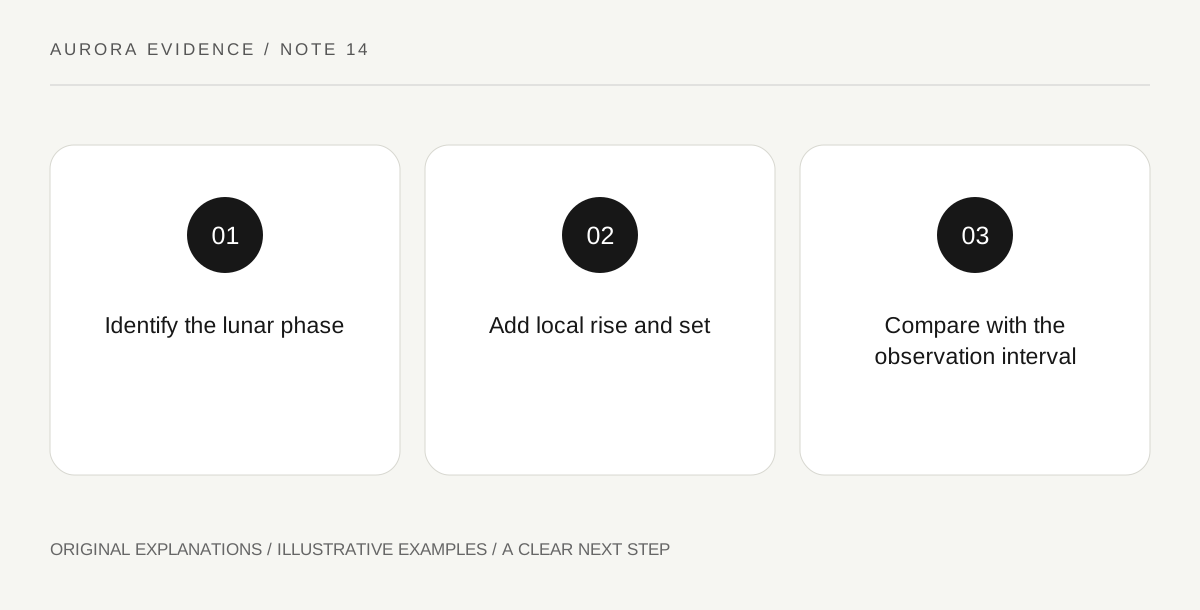
Original explanatory diagram. Read the full method and limitations below.
Read the phase as geometry
NASA explains lunar phases through the changing view of the Moon’s sunlit portion as it orbits Earth. The familiar crescent, quarter and full appearances are not generally caused by Earth’s shadow passing over the Moon. That distinction matters when explaining why phase follows a cycle and why a phase icon is shared broadly across the planet. The icon describes illumination rather than a local weather condition. It does not show cloud cover, the brightness of nearby lamps or the position of a hill that blocks your view. Keep those local factors separate from the astronomical geometry.
Add the local horizon window
The Moon’s rise and set relate to its phase, but an actual observation needs the times for the location and date concerned. A full Moon is generally associated with rising around sunset and setting around sunrise; that broad relationship is not a precise local timetable. Latitude, date and horizon conditions matter when applying it. Use a suitable location-specific astronomical prediction for exact planning, and read the time zone attached to it. If a mountain or building blocks part of the sky, the moment the Moon becomes visible to you can differ from a standard open-horizon rise time.
Avoid a single phase rule for aurora
Moonlight can affect the observing environment, but phase alone does not decide whether aurora exists or can be seen. A bright display can still be observed with moonlight, while a moonless evening can have cloud or no visible activity. The useful question is how lunar illumination and position overlap with your available observing interval. Record those factors as part of the scene rather than treating a phase icon as a pass-or-fail trip score. A scientific or photographic goal may call for a different compromise from a casual observation, so make the purpose explicit.
Make a time-based comparison
A practical comparison puts darkness, the Moon’s above-horizon interval and the intended observation interval on the same dated time axis. This can reveal that two evenings with similar phase icons have different local overlaps. Keep the chart illustrative unless its times come from a verified ephemeris for the chosen location. Do not copy a moonrise time from another town or year. After the observation, note actual cloud and apparent glare separately. This creates a record that explains the viewing environment without claiming that the Moon was the sole cause of success or failure.
Illustrative overlap chart
Consider a fictional observation from 20:00 to 22:00. In one invented scenario the Moon is above the horizon throughout; in another it rises after the interval. The same simplified phase icon appears on both example cards. The comparison demonstrates why position and timing add information. It does not supply actual astronomical times for any Nordic destination or predict whether aurora will occur.
Practical checks
Optional checkboxes save only in this browser.
Questions that come up
Does a new Moon guarantee good viewing?
No. It removes one source of lunar illumination from the night sky, but auroral activity, cloud, darkness and the local environment remain separate factors.
Can I use a phase calendar from any year?
Use the correct date and year, and add local rise-and-set information when timing matters. A generic phase diagram explains geometry rather than a specific evening.
References and scope
These sources support the factual background. Examples and exercises are original illustrative teaching material. References do not imply endorsement.
- NASA: Moon phases — Phase, reflected sunlight and the need for local rise/set predictions.